JournalReading a photograph · 1 of 1
How long is long enough?
Signal grows with time and noise grows with its square root. That single fact decides how you spend every clear night you get.
- Technique
- Physics
On this page
Every astrophotograph carries a number that outsiders find baffling and insiders quote like currency: total integration time. Ten hours. Twenty-five hours. The occasional monster at two hundred.
It is not endurance for its own sake. It comes out of one piece of statistics that shapes every decision you make about a clear night.
Signal adds. Noise doesn't.
Point a sensor at a faint galaxy and photons arrive at some average rate. Leave it twice as long and you collect twice as many. Signal grows linearly with time — that part is intuitive.
Noise does not. The dominant term in a well-cooled camera under a dark sky is photon noise, which exists because photons arrive at random rather than on a schedule. Count N of them and the count carries an uncertainty of about √N. So noise grows too, but only as the square root.
SNR ∝ N / √N = √N
Signal over noise: N over root N is root N. Four times the exposure buys twice the signal-to-noise, not four times.
That square root is the whole economics of the hobby.
What the square root costs you
Diminishing returns are built in, and steeply:
- 1 hour → your baseline
- 4 hours → 2× the signal-to-noise
- 9 hours → 3×
- 25 hours → 5×
Getting from one hour to four is a single good night and it doubles your result. Getting from nine hours to twenty-five is four more nights for a 66% gain that most viewers will not notice.
So the honest answer to how long is: long enough that the target is clearly above the noise, and then rather more than that if it has faint outer structure you care about. It is not a number anyone can give you without knowing the target and the sky.
Why sub-exposure length is a different question
Total integration and sub length are often confused, and they answer different things.
Total time sets your signal-to-noise. Sub length decides how much read noise you accumulate and how much you lose to a satellite, a gust or a guiding excursion. Modern CMOS sensors have low enough read noise that shorter subs cost very little, which is why 120-second frames are now common where 900 was once standard.
The rule of thumb is to expose long enough that sky background — not read noise — dominates a single frame, then stop. Under a bright suburban sky that happens fast; the sky itself fills the well. Under Bortle 2 it takes far longer, which is one of several reasons dark skies are worth driving to.
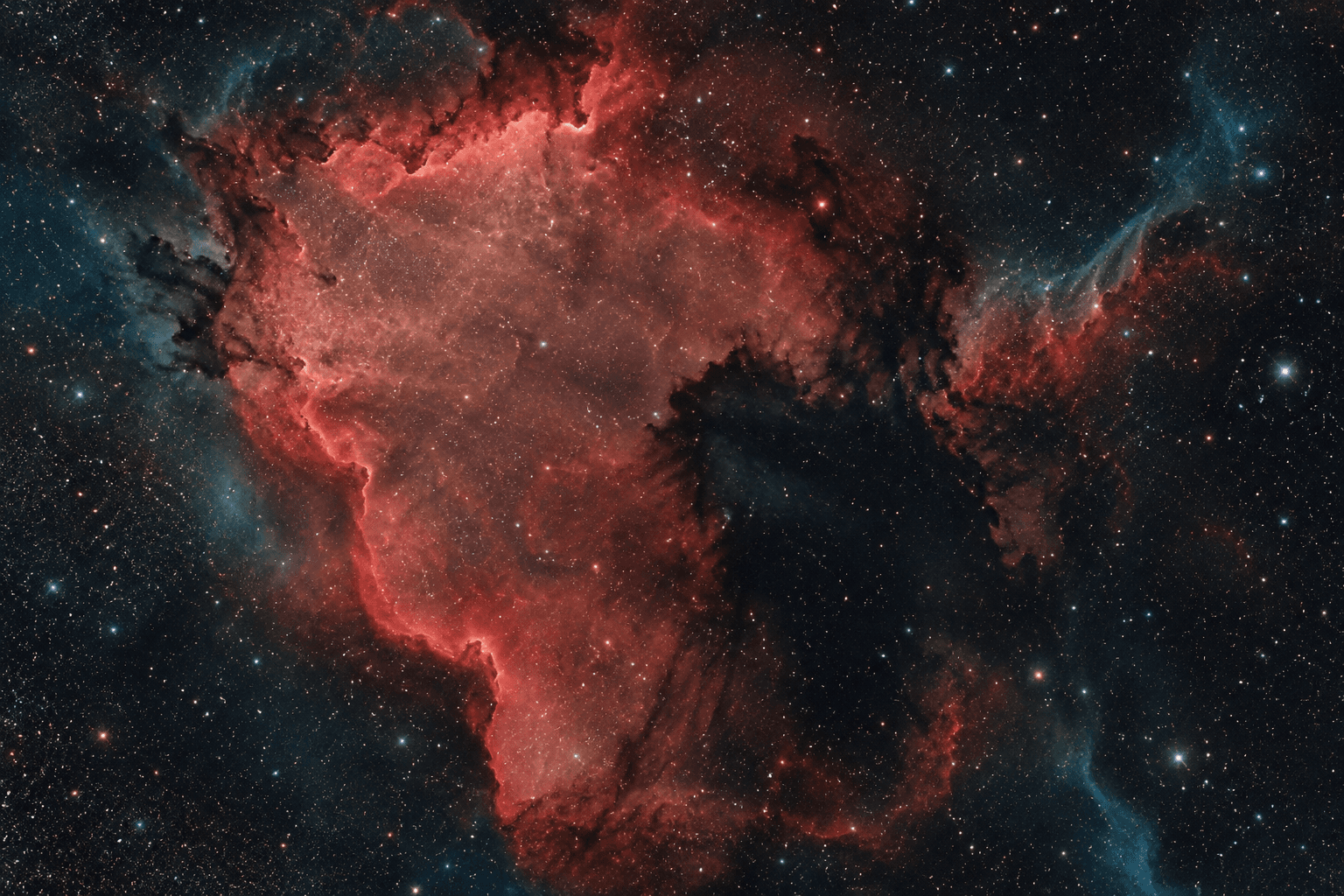
North America Nebula in narrowband
NGC 7000 · Caldwell 20 · 3.37° field
Shot through a three-quarter moon on purpose — 7 nm narrowband barely notices it, which is the entire argument for the filters.
10 h · Askar FRA400 quintuplet · Bortle 7
That example is a mono narrowband set: ten hours, split three ways across Hα, OIII and SII. Narrowband changes the arithmetic considerably, because a 7 nm filter rejects almost everything a streetlight emits while passing the line you want. The sky background term collapses, and suddenly a three-quarter moon is not a reason to stay indoors.
What actually limits you
For most people, most of the time, it is not integration. It is:
- Clear nights, of which there are fewer than you think
- Seeing, which sets your resolution regardless of aperture
- Guiding, because bloated stars cannot be recovered in processing
- Focus drift, which quietly ruins the back half of a session
Ten hours of mediocre data does not beat three hours of good data. The √N law tells you what more time buys; it says nothing about what the time was worth.