Why Mars goes backwards
For two thousand years the retrograde loop was the hardest problem in astronomy. It is a parallax effect, and you can watch it happen.
- Physics
- Object
On this page
Every couple of years Mars stops. Over a few weeks it slows against the background stars, reverses, traces a loop or a zigzag depending on where it sits relative to the ecliptic, then turns round and carries on east as though nothing happened.
This was the hardest problem in astronomy for roughly two thousand years. It is also, once you have the right picture, almost embarrassingly simple.
What the Greeks were up against
The commitment was to uniform circular motion. Everything in the heavens moved in circles, at constant speed, because circles were perfect and the heavens were perfect. Retrograde motion is neither uniform nor circular, so it had to be built out of things that were.
Ptolemy's answer was the epicycle: Mars rides a small circle whose centre rides a large one. Get the two radii and the two rates right and the combination traces a loop. It worked. It predicted positions well enough to be used for fourteen centuries, which is a far better run than most theories manage.
The trouble was that it explained nothing. Why should Mars ride a second circle? Why is the loop always exactly at opposition, when Mars is opposite the Sun and at its brightest? Ptolemy could reproduce the fact but not connect it to anything else.
The actual answer
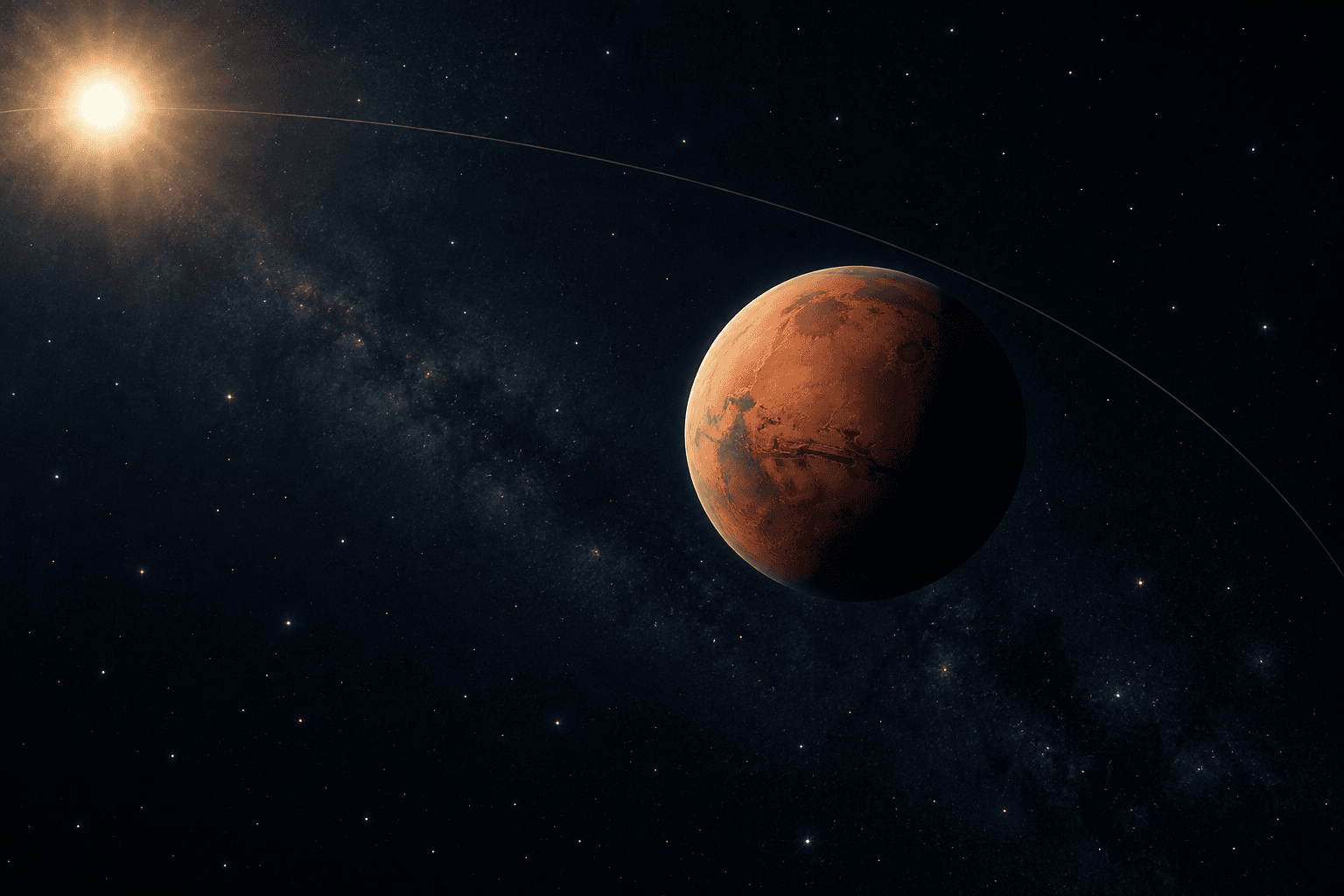
Earth is on a shorter track and moving faster. Every 780 days it catches Mars up and passes it on the inside, and while it does, Mars appears to slide backwards — the same way a slower car seems to drift rearward as you overtake it.
That is the whole explanation. The loop is not something Mars does; it is something we do.
- Mercury
- 88 d
- Venus
- 225 d
- Earth
- 365 d
- Mars
- 687 d
It falls straight out of the picture that the loop happens at opposition. That is precisely the moment Earth is between Mars and the Sun — the moment of overtaking. Ptolemy had to impose that timing on his epicycles as an extra rule. Copernicus got it for free.
Where the 780 days comes from
Mars takes 687 days to orbit. Earth takes 365 (Standish & Williams 2006). You might expect them to line up every 322 days, but alignment depends on the difference in their angular rates, not on either rate alone — the same reason two runners on a circular track lap each other at a rate set by how much faster one is.
1 / T_syn = | 1/T_earth − 1/T_mars |
Subtract the angular rates rather than the periods. For Mars this gives 780 days, which is why oppositions drift through the calendar by about seven weeks each time rather than recurring on the same date.
This is the synodic period, and it is the number that actually governs an observing calendar. Nobody plans a session around Mars's 687-day year.
Why some oppositions are worth far more than others
Not all overtakings are equal. Mars has an eccentricity of 0.093, which is high for a major planet, so its distance from the Sun varies by nearly 20% through its year. Catch it at opposition and near its perihelion and it comes within about 56 million kilometres. Catch it at aphelion and it stays over 100 million away.
The difference at the eyepiece is not subtle:
- A perihelic opposition shows a disc about 25 arcseconds across
- An aphelic one gives barely 14 arcseconds
Same planet, same telescope, roughly three times the area. It is why imagers talk about 2003 and 2018 the way other people talk about vintages, and why the geometry of the orbit matters as much as the calendar.
Watching it yourself
You do not need equipment. Note Mars against a couple of fixed stars once a week through an opposition and plot the positions on paper. The loop takes about ten weeks to trace out and it is unmistakable.
That is the same observation Tycho Brahe made to arcminute precision without a telescope, and the data Kepler spent years fitting until he gave up on circles altogether. The measurement is genuinely within reach of a notebook and some patience — which is worth remembering when the hobby starts to feel like it is mostly about equipment.
Sources
Standish & Williams (2006), Approximate Positions of the Planets, JPL Solar System Dynamics. https://ssd.jpl.nasa.gov/planets/approx_pos.html
The Keplerian elements and per-century rates this site solves for every position, including the synodic period quoted here.